‘Bunkol’ for the best ‘dinorado’ rice
By Rhaydz B. Barcia, Correspondent
LIGAO CITY, Albay: On top of Kawa-Kawa hill in this city, upland farmers use bunkol in planting seedlings of dinorado, a variety of palay (unhusked rice) that produces aromatic and expensive rice usually eaten by wealthy families in the Bicol Region.
Bunkol, a long, perforated and slotted bamboo tube, when used to pound the ground produces a sound similar to that made by a drum.
Kawa-Kawa hill is about 236 meters above sea level and offers a good view of Tuburan barangay (village) in Ligao City. Atop is an eight-hectare farmland.
Downhill are the Carmelite Sisters convent and the resettlement houses for those who had been dislocated by rumblings of Mayon Volcano and typhoons.
The upland farmers still practice bunkol, primitive farming and after which the bamboo tube was named. Also known as hasok, bunkol, apparently, has defied modern farming methods.
As the farmers pound the soil with the bunkol, women from Tuburan place seeds on holes made through the pounding, in a seeming ritual called bubod.
“The bunkol way of dinorado rice planting was practiced by our ancestors. We want to continue with it and show it to the younger generation as an effective farming method,” former Albay governor Fernando Gonzalez told The Manila Times.
Gonzalez said bunkol the bamboo tube also serves as a means of communication especially among those living in potentially hazardous areas.
Albay farmers use ‘bunkol’ in rice planting
By Rhaydz B. Barcia
LIGAO CITY --- On top of Kawa-Kawa hill in this city, upland rice farmers use “bunkol” tools in planting Dinorado seedlings, a variety of rice that produces first class and very aromatic grains favored by wealthy families in Bicol.
Bunkol is a long bamboo tube with knifelike shape on the lower portion to perforate the dregs, having a slot running its length.
As it pounds the ground, it produces a sound that reverberates far and wide like a talking drum. The Kawa-Kawa Hill has about 236-meter elevation from the ground that provides a panoramic view of the city and beyond.
The hill looks like a giant frying pan overlooking the city. Downhill is the Carmelite Sisters and a resettlement area where typhoon victims and those displaced by the the most recent flashfloods from Mt. Mayon are now safely housed.
Several upland farmers, with their women carrying Dinorado seedlings, were en sowing in the ‘bunkol’ or ‘hasok’ manner which is primitive way of farming still being practiced by upland farmers here despite the modern techniques being employed by most farmers in the lowland.
The upland farmers work faster with their “bunkol tools” creating a humming sound while the women make “bubod” (inseminating) of the seeds on the holed grounds. Former Albay Gov. Fernando Gonzalez said the bunkol type of farming is Dinorado rice planting introduced by the upland farmers’ ancestors.
He said ‘bunkol’ is traditionally used as an instrument to communicate with fellow settlers who are situated in distant villages, especially those in hazard prone areas.
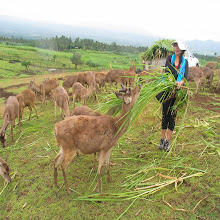
BUNKOL FARMING. Up the Kawa-Kawa hill in Ligao City, upland farmers use the Bamboo tools during the planting of Dinorado rice variety. RHAYDZ B. BARCIA